Tech in the Community: A Real-Time Revolution for Electronic Monitoring
When someone on probation wears an electronic tag, the goal is clear: support their rehabilitation while keeping the public safe. But currently, the feedback loop for when things go wrong—like a missed curfew—is often too slow. Probation Practitioners (PPs) sometimes don't find out about a violation until a full "breach pack" arrives days later, and device wearers may not even realise they’ve triggered an alert until it’s too late to correct their behaviour.
Enter E-Surveillance, a new concept from the Ministry of Justice aimed at using real-time technology to increase compliance and improve communication.
The Vision: Instant Feedback, Faster Course-Correction
The core of E-Surveillance is simple: if a person on probation violates their tag conditions, they—and their Probation Officer—get notified immediately.
By sending a real-time SMS to the device wearer, the service aims to:
Demonstrate Monitoring: Prove that the tags are being watched in real-time.
Prompt Course-Correction: Give the individual a chance to stop a potential breach immediately (e.g., "Go home now")
Reduce Anxiety: Use supportive language to explain what happened and provide a contact number for clarification, reducing the "panic" that can lead to total disengagement.
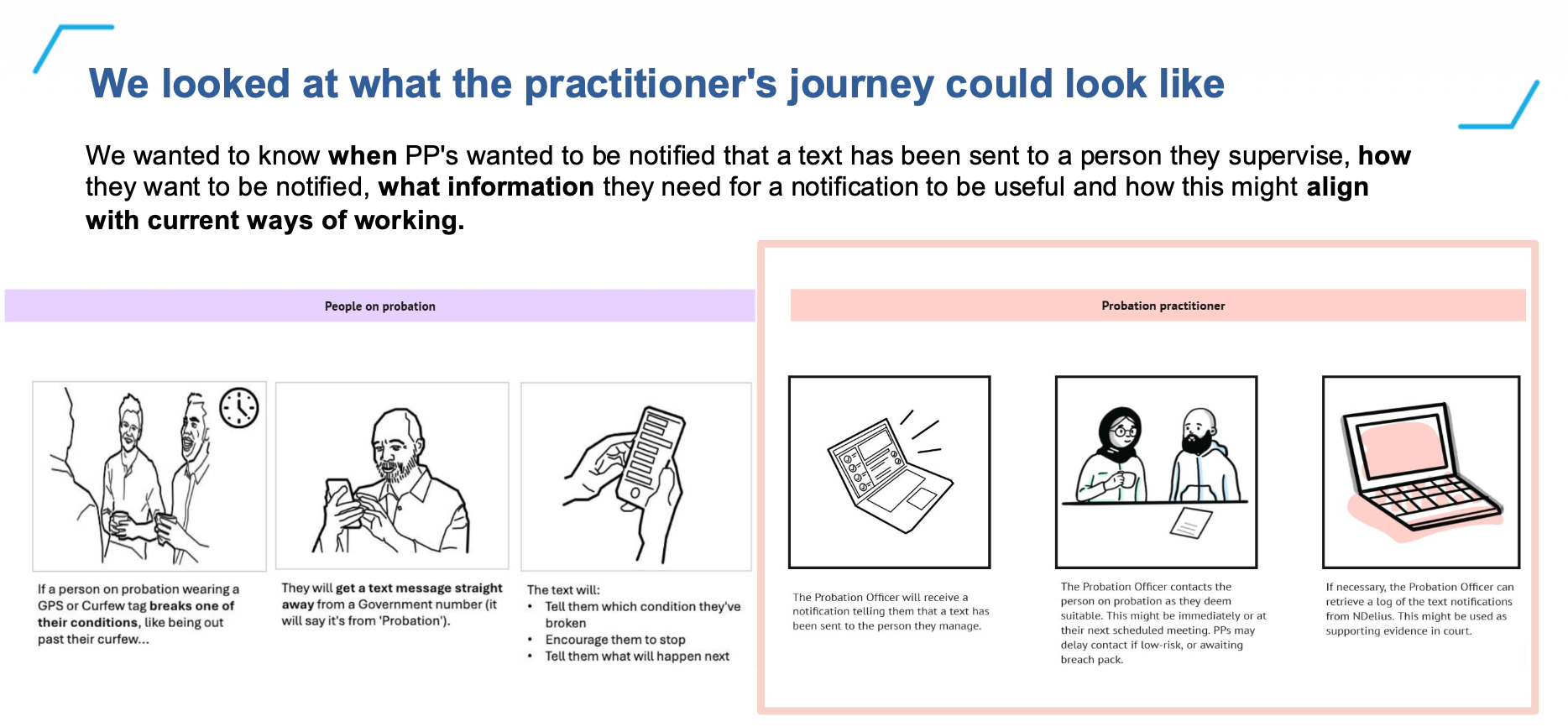
We co-designed the practitioners' journey with them
Co-Designing the "Perfect" Text Message
Words matter. The project team didn't just guess what the text should say; they held three rounds of design and testing with 19 practitioners and 9 former or current device wearers.
“It’s like ‘they’re still watching me’ – some people need this. When you don’t hear, you think ‘I’ll take a chance’.”
The evolution of the text message shows the balance between being firm and supportive:
Round 1: Tested three options: Stern, Neutral, and Supportive.
Round 2: Narrowed it down to "More Firm" and "More Supportive". Device wearers strongly preferred supportive language like "We understand there may be a reason this happened".
The MVP Version: A final iteration that uses the person's first name, provides clear instructions, and includes an automated reply warning.
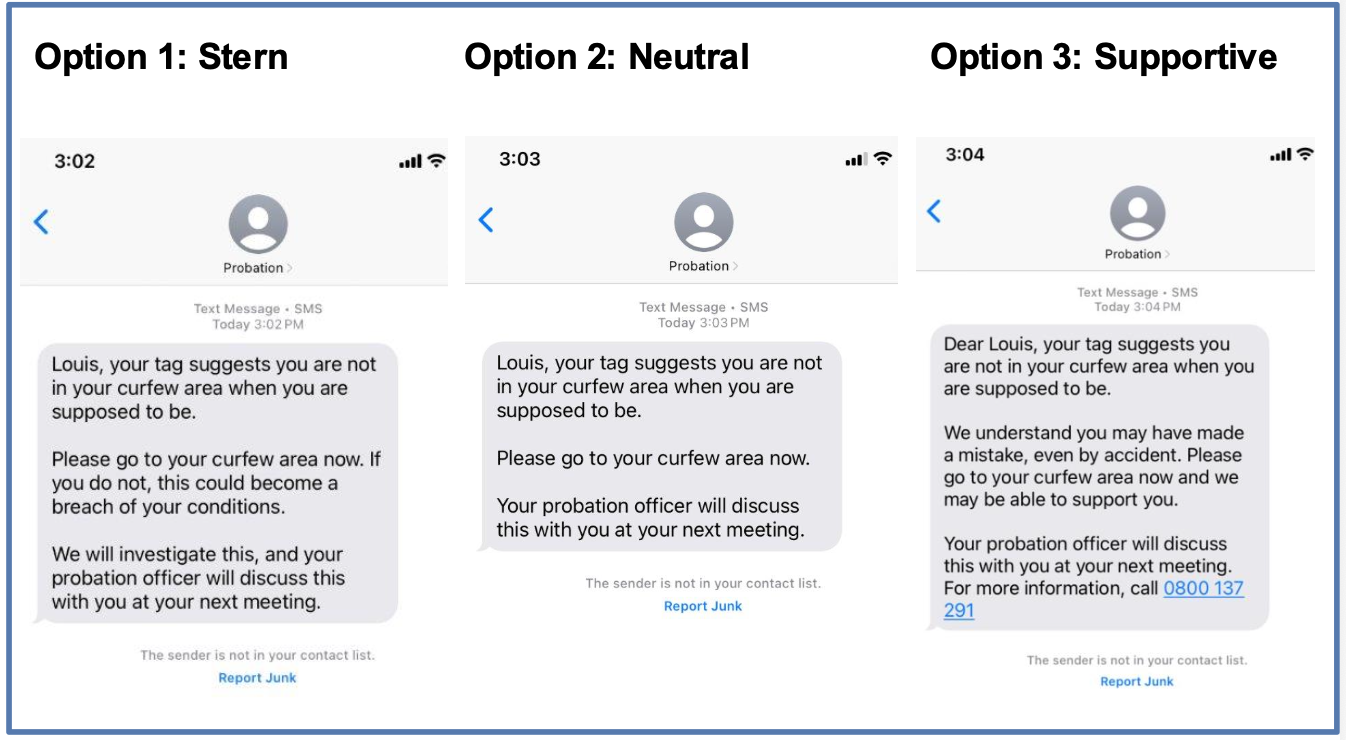
We collaborated with MOJ Chief Psychologist team, Behavioural Research UK in the Go-Science Office, as well as policy and operational subject matter experts, to design potential wording options for the device wearer texts.
Empowering the Practitioner
For Probation Practitioners, receiving an email at the same time as the device wearer's text provides a vital "head start". It allows them to manage risk faster and be prepared for a phone call if the device wearer reaches out to explain themselves.
Importantly, this record is also logged automatically in the case management system, ensuring there is a clear digital trail of the violation and the service's attempt to intervene.
The Technical Hurdle: Real Data Matters
While the prototype successfully proved the concept, the team hit a critical roadblock: data reliability. Poor data quality and inconsistent updates from third-party suppliers mean that, for now, the project is paused until the in-house data foundations are stabilised.
Building a real-time alerting service on unreliable data would lead to "false positives"—alerts being sent when no violation actually occurred—which would damage trust in the entire system.
What’s Next?
The E-Surveillance prototype has proven that real-time notifications are both feasible and highly desired by those on both sides of the tag. Once live data becomes reliable, we recommend a live pilot with a diverse cohort of device wearers to measure the long-term impact on compliance and reoffending.
By bridging the gap between a violation and a response, E-Surveillance isn't just about watching; it's about helping people stay on the right path.