Focus not fret
Earlier this week, I joined my colleagues at TPXimpact for our away day. These events are usually a great chance to reconnect, but I didn't expect to walk away with a completely new perspective on my own creative blocks and professional habits.
The highlight was a talk by Bonita Norris, who shared her journey from being a novice climber to standing on the summit of Mt. Everest. As she spoke about the "mountains of the mind," I found myself reaching for a pen.
I haven't picked up a pen for a long time. Lately, my spare time has been dominated by racket sports, and my sketching skills felt "rusty." I felt a flicker of anxiety about drawing in public, let alone sharing the result. But as Bonita spoke, I realized that my hesitation was the perfect example of the "hall of mirrors" she was describing—that internal noise that tells us we aren't ready or capable.
I decided to overthink less and do more. Here is the sketch note I captured during the session, and the three key lessons that stuck with me.
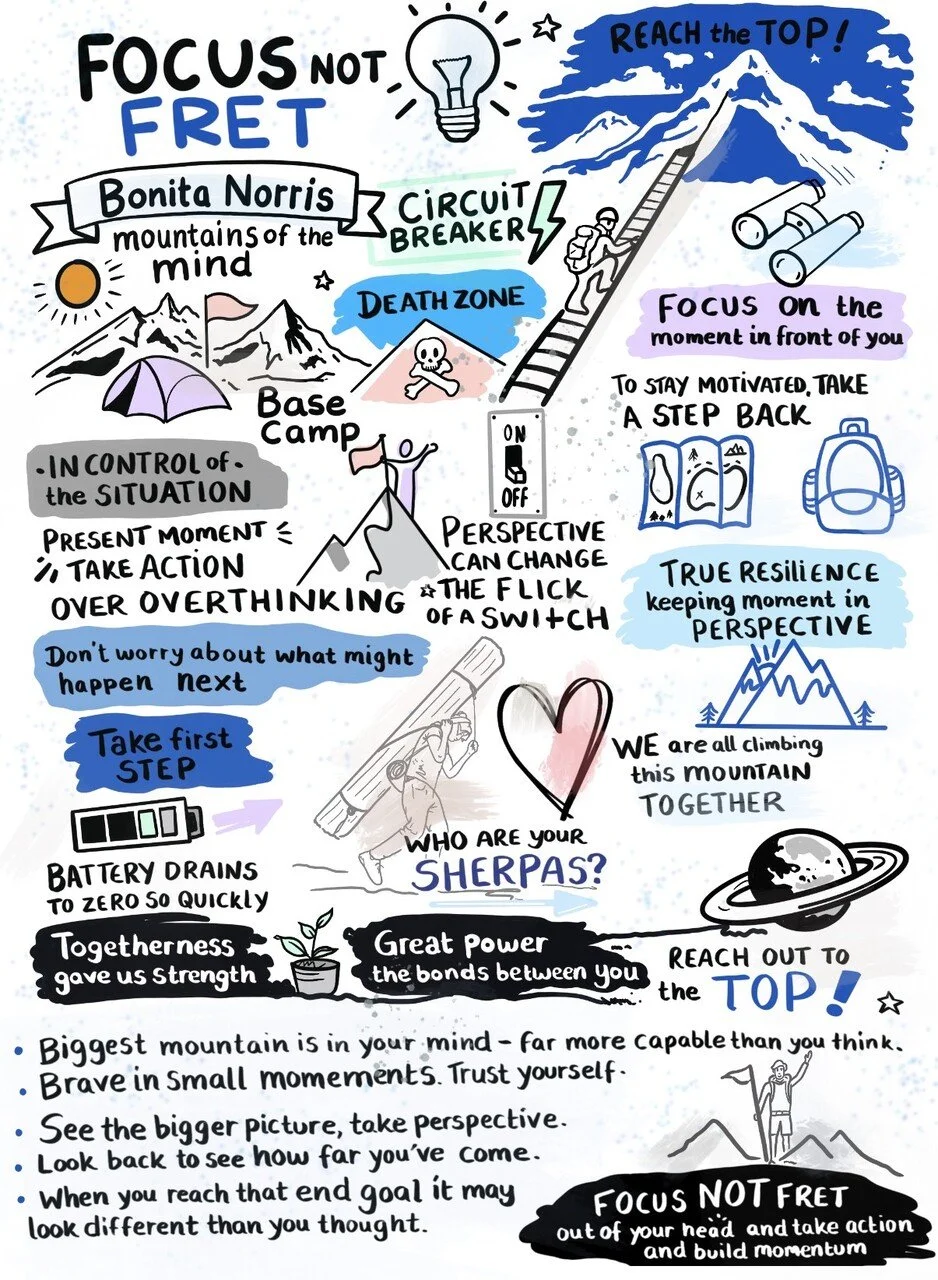
1. Focus on the Ground Beneath Your Feet
When you’re staring at a peak like Everest—or a massive project at work—it’s easy to get "frozen on the ladder." The scale of the task becomes overwhelming, and we start to fret about things that haven't happened yet.
Bonita’s advice was a "circuit breaker" for overthinking: Focus on the ground beneath your feet. When we stay in the present moment and take action on the immediate step in front of us, we build the momentum needed to move through the "death zone" of a project.
2. Who is on Your Rope?
In a world of remote and hybrid work, it is easy to feel like we are operating in our own isolated worlds. Bonita reminded us that while the individual takes the steps, it takes a village to get a person to the top.
She spoke about the "Sherpa support team" and the power of the "tap on the shoulder." It’s a reminder that great teams are built in the small details—the small, conscious efforts to reach out and strengthen bonds. True resilience isn't just a solo grit; it’s the togetherness that gives us strength when our "batteries are drained to zero."
3. Being Brave in Small Moments
We often think of bravery as a massive, heroic act. But on a mountain, bravery is often just the decision to take one more step when you’re exhausted.
In our professional lives, bravery is reaching out to break a silence, asking for help, or—in my case—sharing a piece of work that you feel is "imperfect." Perspective can change at the flick of a switch. When we look back from the summit, we realize the "mountain" was often just a series of moments that we had the power to navigate all along.
Final Thoughts
As Tenzing Norgay famously said in 1953: "Be great, make others great."
Bonita’s talk was the nudge I needed to get out of my head and back into a creative flow. I’m planning to keep the pen moving this year, focusing less on the "rusty" start and more on the journey ahead.
What are the mountains in your mind right now, and who are the Sherpas helping you climb them?